Comparison · Anthropic and Z.ai
Claude Sonnet 5.5 vs GLM 5.3
Listed API prices of Claude Sonnet 5.5 and GLM 5.3 turned into the cost of the same three standard tasks, with speed from our own test requests in the United States and what each provider’s API documentation says about features that break on a switch. Output quality and answer length are not compared.
Calculated impact cost per task and per month
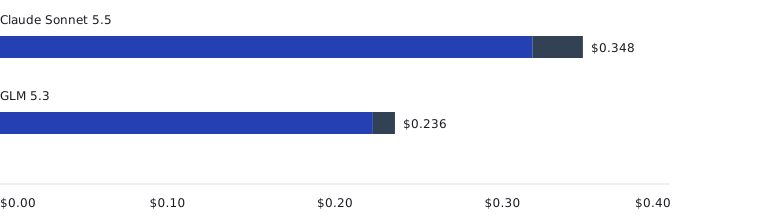
For an L2 task (deep analysis over a 50,000-token document, 3 steps), Claude Sonnet 5.5 costs $0.348 and GLM 5.3 $0.236 at the prices listed in the United States on , so Claude Sonnet 5.5 is 47.6 % more than GLM 5.3, counting visible output only, without cache discounts or hidden reasoning.

| Task | Claude Sonnet 5.5, per task | GLM 5.3, per task | Claude Sonnet 5.5, per month | GLM 5.3, per month | Claude Sonnet 5.5 vs GLM 5.3, per task |
|---|---|---|---|---|---|
| L1Micro-task (classification or strict JSON extraction) | $0.0050per L1 task | $0.0030per L1 task | $73.00per month | $43.51per month | +67.8 % |
| L2Deep analysis over a 50,000-token document | $0.348per L2 task | $0.236per L2 task | $5,080.80per month | $3,442.68per month | +47.6 % |
| L3Agentic coding loop, 15 steps | $2.72per L3 task | $1.88per L3 task | $39,726.60per month | $27,466.98per month | +44.6 % |
Calculated Per month: 20 tasks an hour around the clock, 730 hours.
Prices USD per 1M tokens
| Price | Claude Sonnet 5.5 | GLM 5.3 |
|---|---|---|
| Input, per 1M tokens | $2.00 | $1.40 |
| Output, per 1M tokens | $10.00 | $4.40 |
| Price from | Provider's price list · source page Published | Provider's price list · source page Published |
| Read | · the United States | · the United States |
| Context window | 1,000,000 tokens | 1,048,576 tokens |
What can I use it for? six common tasks, our data checks
Quality on your task: not measured by Measured Lab yet.
| Task | Claude Sonnet 5.5 | GLM 5.3 |
|---|---|---|
| Answer customer messages | Fits on price and context | Fits on price and context |
| Pull data from invoices and documents with strict JSON and page images | Fits on price and context | Not confirmed: reads text only, per the OpenRouter listing |
| Summarize documents and meetings | Fits on price and context | Fits on price and context |
| Translate content | Fits on price and context | Fits on price and context |
| Chat assistant on your website | Fits on price and context | Fits on price and context |
| Write and review code with tool calls | Fits on price and context | Fits on price and context |
| Tasks it fits | 6 of 6 | 5 of 6 |
Checks of our data for six common tasks: a published price, a context window and answer length for the task and, where the task needs them, strict JSON output, page images and tool calls; prices, cost a month and terms for each model on its model card. Compare models for your own task in the model picker.
Speed in the US Observed our test requests
In our test requests from the United States, the median time to the first answer token was 961 ms for Claude Sonnet 5.5 (Direct API · Anthropic) and 1,934 ms for GLM 5.3 (Direct API · Z.ai).
| Model and route | Time to first answer token, median | Output speed, median | Answers |
|---|---|---|---|
| Claude Sonnet 5.5Direct API · Anthropic | 961 ms range 363 ms–8,537 ms | 115 tokens/s range 67.7 tokens/s–244 tokens/s | 115 answers on 23 dates |
| GLM 5.3Direct API · Z.ai | 1,934 ms range 849 ms–7,367 ms | 70.7 tokens/s range 26.8 tokens/s–471 tokens/s | 114 answers on 23 dates |
| GLM 5.3OpenRouter → Z.AI | 2,191 ms range 1,092 ms–32,480 ms | 69.7 tokens/s range 22.8 tokens/s–610 tokens/s | 115 answers on 23 dates |
The same short request to every model, sent from a measurement point in the United States; medians of successful answers on at least 2 different dates, latest on . How we measure
What breaks when you switch Published provider documentation
Moving from Anthropic to Z.ai, 4 of the 5 features may not carry over, by each provider’s documentation:
- Strict JSON schemas — Anthropic: yes; Z.ai: partly. Code that parses answers without checks starts failing where a provider promises only valid JSON, not your schema.
- Parallel tool calls — Anthropic: yes; Z.ai: not stated. An agent built around several calls per turn gets one call per turn: more round trips, more input tokens, slower runs.
- Streamed tool arguments — Anthropic: yes; Z.ai: partly. An interface that shows arguments as they are written sees nothing until the whole call is ready.
- Cache covers tool definitions — Anthropic: yes; Z.ai: not stated. Where the cache does not cover tool definitions, a long tool list is paid as fresh input on every request.
Moving from Z.ai to Anthropic: every feature that Z.ai’s documentation lists as supported is also listed as supported by Anthropic.
| Feature of the API | Anthropic | Z.ai |
|---|---|---|
| Strict JSON schemas | Yes | Partly |
| Parallel tool calls | Yes | Not stated |
| Streamed tool arguments | Yes | Partly |
| Reasoning with tools | Yes | Yes |
| Cache covers tool definitions | Yes | Not stated |
What each provider’s own API documentation says, read ; “not stated” is not the same as “no”. Quotes and sources: what breaks when you switch AI APIs.