Comparison · OpenAI and Qwen
GPT-5.4 Nano vs Qwen3.8 Flash
Listed API prices of GPT-5.4 Nano and Qwen3.8 Flash turned into the cost of the same three standard tasks and what each provider’s API documentation says about features that break on a switch. Output quality, speed and answer length are not compared.
Calculated impact cost per task and per month
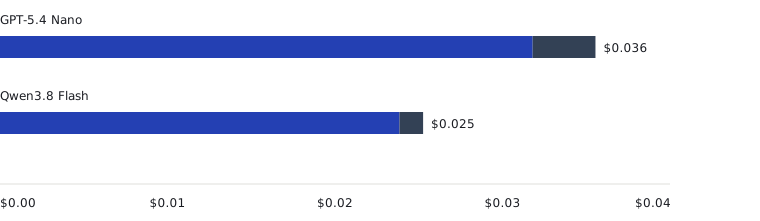
For an L2 task (deep analysis over a 50,000-token document, 3 steps), GPT-5.4 Nano costs $0.036 and Qwen3.8 Flash $0.025 at the prices listed in the United States on , so GPT-5.4 Nano is 40.7 % more than Qwen3.8 Flash, counting visible output only, without cache discounts or hidden reasoning.

| Task | GPT-5.4 Nano, per task | Qwen3.8 Flash, per task | GPT-5.4 Nano, per month | Qwen3.8 Flash, per month | GPT-5.4 Nano vs Qwen3.8 Flash, per task |
|---|---|---|---|---|---|
| L1Micro-task (classification or strict JSON extraction) | $0.0006per L1 task | $0.0003per L1 task | $8.03per month | $4.66per month | +72.4 % |
| L2Deep analysis over a 50,000-token document | $0.036per L2 task | $0.025per L2 task | $519.03per month | $368.80per month | +40.7 % |
| L3Agentic coding loop, 15 steps | $0.274per L3 task | $0.202per L3 task | $4,005.51per month | $2,942.70per month | +36.1 % |
Calculated Per month: 20 tasks an hour around the clock, 730 hours.
Prices USD per 1M tokens
| Price | GPT-5.4 Nano | Qwen3.8 Flash |
|---|---|---|
| Input, per 1M tokens | $0.200 | $0.150 |
| Output, per 1M tokens | $1.25 | $0.470 |
| Price from | OpenRouter · source page (data) Published | Provider's price list · source page Published |
| Read | · the United States | · the United States |
| Context window | 400,000 tokens | 1,000,000 tokens |
What can I use it for? six common tasks, our data checks
Quality on your task: not measured by Measured Lab yet.
| Task | GPT-5.4 Nano | Qwen3.8 Flash |
|---|---|---|
| Answer customer messages | — | Fits on price and context |
| Pull data from invoices and documents with strict JSON and page images | — | Not confirmed: strict JSON output partly, per Alibaba Cloud’s documentation |
| Summarize documents and meetings | — | Fits on price and context |
| Translate content | — | Fits on price and context |
| Chat assistant on your website | — | Fits on price and context |
| Write and review code with tool calls | — | Fits on price and context |
| Tasks it fits | — | 5 of 6 |
Checks of our data for six common tasks: a published price, a context window and answer length for the task and, where the task needs them, strict JSON output, page images and tool calls; prices, cost a month and terms for each model on its model card. GPT-5.4 Nano is not in the model picker. Compare models for your own task in the model picker.
What breaks when you switch Published provider documentation
Moving from OpenAI to Qwen, 3 of the 5 features may not carry over, by each provider’s documentation:
- Strict JSON schemas — OpenAI: yes; Qwen: partly. Code that parses answers without checks starts failing where a provider promises only valid JSON, not your schema.
- Streamed tool arguments — OpenAI: yes; Qwen: not stated. An interface that shows arguments as they are written sees nothing until the whole call is ready.
- Cache covers tool definitions — OpenAI: yes; Qwen: not stated. Where the cache does not cover tool definitions, a long tool list is paid as fresh input on every request.
Moving from Qwen to OpenAI: every feature that Qwen’s documentation lists as supported is also listed as supported by OpenAI.
| Feature of the API | OpenAI | Qwen |
|---|---|---|
| Strict JSON schemas | Yes | Partly |
| Parallel tool calls | Yes | Yes |
| Streamed tool arguments | Yes | Not stated |
| Reasoning with tools | Yes | Yes |
| Cache covers tool definitions | Yes | Not stated |
What each provider’s own API documentation says, read ; “not stated” is not the same as “no”. Quotes and sources: what breaks when you switch AI APIs.